Alluvial Gold Wash Plant | Mobile Placer Gold Washing & Gravity Recovery Equipment
1. Process Overview
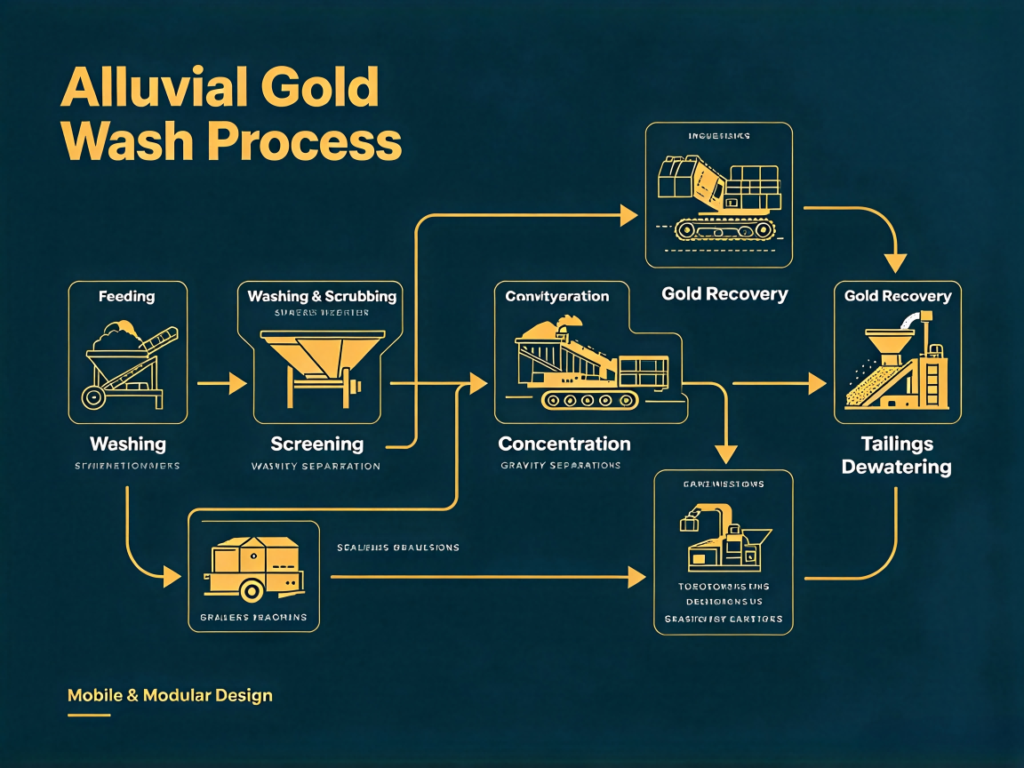
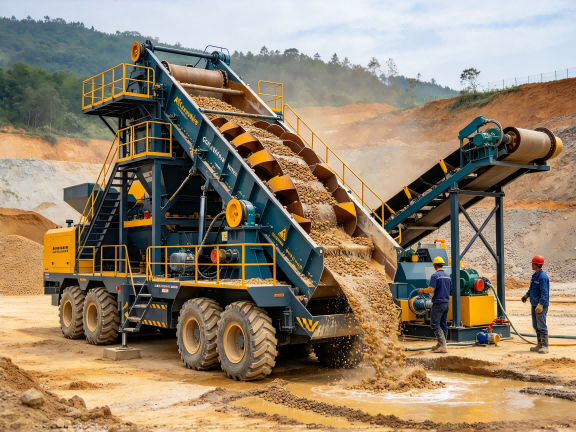
The alluvial gold wash plant is a complete gravity separation line designed for placer gold deposits — gold-bearing sand and gravel deposited in riverbeds, valleys, ancient river channels and beach terraces. Raw ore is fed into a vibrating hopper, washed and scrubbed in a rotary trommel to break clay lumps and screen out oversize rocks. The undersize slurry flows to a sluice box and/or centrifugal concentrator where dense gold particles are captured by gravity. Concentrated gold-rich material is then upgraded on a shaking table or panned manually to produce final gold concentrate. No cyanide, no chemicals — pure physical gravity separation, environmentally friendly and suitable for small-to-medium mining operations.
Our alluvial gold wash plants are built on a modular skid or wheeled mobile frame, allowing fast deployment to remote river sites. They are widely used by artisanal-to-medium scale gold miners across Africa, South America, Central Asia and Southeast Asia, delivering immediate gold recovery within days of site setup.
2. Suitable Gold Ore Types
Ideal Ore:
- Alluvial / placer gold deposits in riverbeds and valleys
- Eluvial gold gravel from weathered gold veins
- Beach gold and gold-bearing sand terraces
- Clay-bound gold gravel that requires scrubbing and washing
- Mixed ore with clay, sand, gravel and boulders
Requires Additional Equipment or Not Recommended:
- Hard rock lode gold (requires crushing and grinding, not just washing)
- Very fine “flour gold” in clay (requires enhanced sluice with matting and centrifugal concentrator)
- Heavy black sand with high magnetite content (needs magnetic separation downstream)
- Gold ore embedded in solid bedrock (not alluvial)
3. Core Advantages of Alluvial Gold Wash Plant
- No Chemicals, Fully Gravity Separation — Pure physical washing and gravity concentration, no cyanide or reagents, environmentally safe and suitable for sensitive river and wetland areas.
- Fast Setup & Immediate Production — Modular skid or wheeled mobile design, delivered in standard containers; on-site setup takes only 3–7 days, gold production starts immediately.
- High Gold Recovery — Combined trommel scrubbing, sluice box with special matting and centrifugal concentrator achieves 90%–95% gold recovery for typical alluvial ore.
- Handles Clay & Boulders — Rotary trommel with water spray breaks clay lumps and washes sticky ore, while rejecting oversize rocks and boulders.
- Low Operating Cost — No grinding media, no chemical consumption, low power requirement (mostly for water pumps and trommel drive), simple operation by 3–5 workers.
- Mobile & Flexible — Wheel-mounted or skid-mounted designs allow relocation when one river section is exhausted; ideal for artisanal and small-scale miners.
- Direct Gold Output — Produces clean gold concentrate / gold dust directly on site, ready for panning, smelting or sale, no intermediate concentrate shipping.
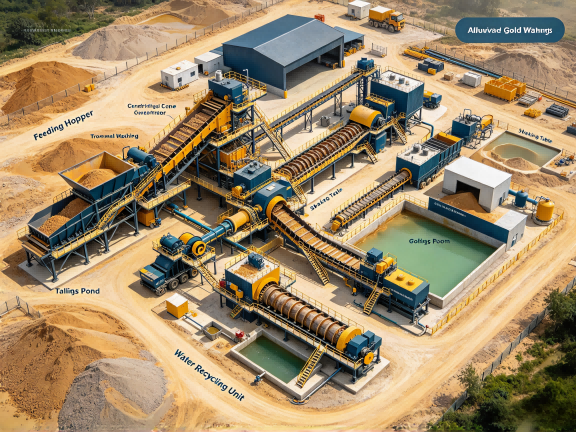
4. Complete Equipment List for Alluvial Gold Wash Plant
4.1 Feeding & Washing System
- Vibratory Feeding Hopper (grizzly bars to reject oversize boulders)
- Rotary Trommel Scrubter (with water spray nozzles inside, breaks clay)
- High-pressure Water Pump & Water Pipeline
- Loading Conveyor / Feeding Belt
4.2 Screening & Gravity Recovery System
- Sluice Box (with special gold-catching matting / riffles)
- Centrifugal Gold Concentrator (Knelson-style, for fine gold recovery)
- Shaking Table (final upgrading of gold concentrate)
- Vibrating Screen (optional, for pre-screening fine fractions)
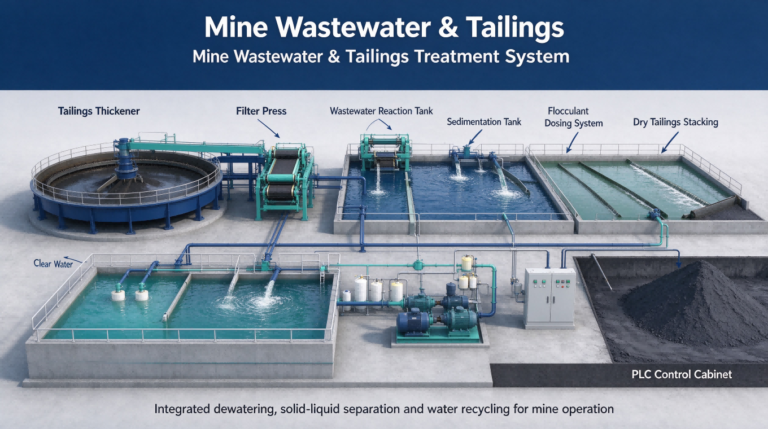
4.3 Tailings & Water System
- Tailings Conveyor or Slurry Discharge Chute
- Water Settling Pond / Recycling Tank
- Slurry Pump (if water recycling is required)
- Motor Control Cabinet
4.4 Optional Upgrades
- Magnetic Separator (to remove black sand / magnetite)
- Mercury-free Gold Smelting Furnace (small batch doré production)
- Generator Set (for remote sites without grid power)
- Dredger / Floating Wash Plant (for river-bottom dredging)
5. Plant Floor Area & Scale Reference
Reference footprint for complete alluvial gold wash plant (skid-mounted / wheeled):
- Small portable plant (10 – 30 TPH) — 150 – 300 m² (single container / skid, towable by truck)
- Medium wash plant (50 – 100 TPH) — 300 – 800 m² (skid-mounted, 2–3 containers)
- Large modular plant (150 – 200 TPH) — 800 – 1,500 m² (multiple skids, on-site assembly)
Layout Note: The wash plant itself has a very small footprint compared with hard rock processing. The main land requirement is the feeding area, settling pond and tailings area. A water source (river, well or pond) must be within pumping distance of the plant.
6. Consumables & Wear Parts
- Sluice Matting / Riffles — Replaceable gold-catching carpet, typically replaced every 3–6 months
- Trommel Screen Mesh — Replaceable screen panels, wear depends on ore abrasiveness
- Water Pump Seals & Impellers — Routine maintenance spares
- Centrifuge Concentrator Liner & Bowl — Replaceable high-wear parts
- Shaking Table Deck Covering — Ripples / carpet replacement
- Conveyor Belt & Idlers — Routine replacement items
- No Chemicals Required — Unlike cyanide CIL or heap leach, no reagents are consumed; only water and electricity are needed to run the plant.
7. Process Flow Summary
Alluvial Gold Ore Feeding → Grizzly Pre-screening (Reject Boulders) → Rotary Trommel Scrubbing & Washing (Break Clay) → Sluice Box Gravity Capture → Centrifugal Concentrator (Fine Gold Recovery) → Shaking Table Upgrading → Clean Gold Concentrate | Tailings to Settling Pond
8. FAQ for Alluvial Gold Wash Plant
Q1: What kind of gold ore can this wash plant process?
A1: It is designed for alluvial / placer gold deposits in rivers, valleys and terraces — gold-bearing sand, gravel and clay. It does not process hard rock lode gold, which requires crushing and grinding equipment.
Q2: Does the plant use cyanide or chemicals?
A2: No. The alluvial gold wash plant uses pure physical gravity separation — washing, screening and gravity concentration. No cyanide, no reagents, fully environmentally friendly and safe for river operations.
Q3: What is the expected gold recovery rate?
A3: For typical alluvial ore with coarse to medium gold, combined sluice box and centrifugal concentrator achieves 90%–95% gold recovery. Very fine “flour gold” may need additional enhanced matting or more centrifugal stages.
Q4: How long does it take to set up and start production?
A4: Skid-mounted and wheeled plants are delivered pre-assembled in containers. On-site setup takes 3–7 days including water connection and electrical commissioning, and gold production starts immediately.
Q5: What capacity options are available?
A5: We offer 10 TPH, 30 TPH, 50 TPH, 100 TPH, 150 TPH and 200 TPH models. Smaller units are wheel-mounted and towable; larger units are modular skids that can be combined for higher throughput.
Q6: Can the plant handle clay-bound gold gravel?
A6: Yes. The rotary trommel scrubber with high-pressure water spray breaks clay lumps and washes sticky ore. For very heavy clay, we recommend adding a pre-scrubbing stage or increasing water pressure.
Q7: Do you provide turnkey service for alluvial gold projects?
A7: Yes. We provide plant design, containerized delivery, on-site installation guidance, operator training, water pump configuration and long-term spare parts support for alluvial gold mining projects worldwide.
Ready to Start Your Alluvial Gold Wash Plant Project?
Send us your ore sample description, gold particle size, feed capacity and site location. Our engineers will recommend the right wash plant model, flow design and quotation for your placer gold operation.
What to send: Ore type / gold particle size / clay content / daily throughput target / water source availability / mine location