Gold CIL Plant 50–200 TPD | Small-to-Medium Scale Carbon-in-Leach Gold Processing Line
1. Process Overview
The Gold CIL (Carbon-in-Leach) Plant 50–200 TPD is a compact, cost-effective modular gold processing solution designed for small-to-medium scale hard rock gold mines. The process combines cyanide leaching and activated carbon adsorption in a single agitated tank circuit: ground gold ore is slurried and leached with dilute sodium cyanide, while granular activated carbon moves counter-current through the same leach tanks, continuously adsorbing dissolved gold. Loaded carbon is then stripped (eluted), and gold is recovered from the eluate by electrowinning before final smelting into gold doré bars.
This 50–200 TPD CIL design is ideal for junior mining companies, prospectors scaling up from artisanal operations, and exploration mines moving into production. It delivers the same gold recovery fundamentals as large CIL plants — proven reagent chemistry, reliable carbon loading and clean final doré — but at a capital and operating footprint that matches small deposits and phased development.
2. Suitable Ore Types
Ideal Ore:
- Free-milling gold ore (native gold in quartz / oxidized ore)
- Oxidized and semi-oxidized gold deposits
- Low-to-medium grade hard rock gold ore (1–10 g/t Au)
- Small tonnage vein gold deposits suitable for 50–200 TPD operation
- Marginal ore that does not justify a full 500+ TPD plant
Requires Pre-treatment or Not Recommended:
- Refractory sulfide gold ore (requires roasting / BIOX / pressure oxidation first)
- High carbonaceous “preg-robbing” ore (needs activated carbon pre-treatment or alternative flowsheet)
- Heavy clay / slime-rich ore (requires pre-desliming)
- Very high-grade nugget ore requiring gravity concentration ahead of CIL
3. Core Advantages of 50–200 TPD Gold CIL Plant
- Lower Capital Entry — Compact layout, smaller equipment, simpler civil works; suitable for junior miners and exploration companies with limited capital.
- Proven Gold Recovery — Standard CIL chemistry delivers 90%–97% gold recovery for free-milling and oxidized gold ore, same principles as large commercial plants.
- Modular & Expandable — Design supports staged build-up: start at 50 TPD, then expand to 100 TPD or 200 TPD by adding parallel grinding and leaching tanks.
- Fast Commissioning — Prefabricated steel structures and skid-mounted equipment reduce on-site construction time to 3–5 months from order to gold production.
- Turnkey Doré Output — End-to-end line produces gold doré bars directly on site (90%–95% Au), ready for refining and sale, no intermediate concentrate shipping.
- Lower Labor Requirement — Automatic dosing, simple control system, can be operated by 8–12 personnel per shift for 100 TPD plant.
- Flexible Site Conditions — Adaptable to remote mine sites with limited infrastructure; modular design allows containerized delivery to Africa, Central Asia, South America and Southeast Asia.
4. Complete Equipment List for 50–200 TPD Gold CIL Plant
4.1 Crushing System
- Jaw Crusher (primary crushing, 200–500 mm feed to 25 mm product)
- Vibrating Grizzly Feeder
- Vibrating Screen (25 mm screening)
- Belt Conveyor (rubber belt, steel structure)
- Fine Ore Bunker / Hopper
4.2 Grinding & Classification System
- Ball Mill (overflow type, 15–35 t/h for 50–200 TPD range)
- Spiral Classifier or Hydrocyclone (P80 150–200 µm target)
- Slurry Pump
- Mill Feed Hopper & Feeder
4.3 Leaching & CIL System
- Leaching / CIL Agitated Tanks (4–6 tanks in series, each with agitator and air lift)
- Carbon Screen (inter-tank screen to retain carbon)
- Activated Carbon (granular, coconut shell / coal base, 6×16 mesh)
- NaCN Dosing System (automatic)
- Lime / CaO Dosing System (pH control 10.5–11.5)
4.4 Elution & Electrowinning System
- Elution Column / Zadra / AARL Elution System
- Electrowinning Cell (steel wool cathode)
- Rectifier / Power Supply
- Elution Solution Heater & Tank
4.5 Smelting & Doré Production
- Induction Smelting Furnace (50–200 kg gold batch)
- Graphite Crucible & Moulds
- Flux Mix (borax, silica, soda ash)
- Doré Bar Casting Mould
4.6 Tailings & Auxiliary System
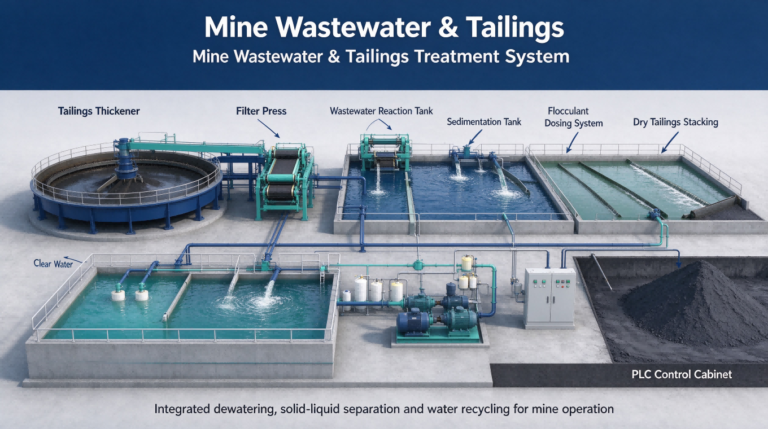
- Tailings Thickener (or slurry pump to tailings pond)
- Process Water Tank & Pump
- Tailings Pump & Pipeline
- Electric Control Cabinet (DCS / PLC basic automation)
- Laboratory Test Equipment (fire assay, pH meter, atomic absorption optional)
5. Plant Floor Area & Scale Reference
Reference land occupation for full CIL processing plant (excluding open-pit mine and tailings facility):
- 50 TPD small-scale plant — 3,000 – 6,000 m² (compact modular layout)
- 100 TPD medium-scale plant — 6,000 – 12,000 m²
- 200 TPD larger plant — 12,000 – 20,000 m² (parallel leaching tanks, expanded grinding)
Layout Note: The CIL plant is typically arranged in a single processing building (crushing → grinding → CIL → elution → smelting), with the tailings facility located downhill by gravity. Modular skid-mounted design minimizes civil construction and allows rapid relocation if needed.
6. Consumables & Reagents
- Sodium Cyanide (NaCN) — Core leaching reagent; typical consumption 0.3–1.5 kg/t ore depending on ore type
- Lime (CaO / Ca(OH)₂) — pH regulator to 10.5–11.5, prevents HCN gas; typical 2–8 kg/t ore
- Activated Carbon — Gold adsorbent; make-up carbon added each cycle, overall loss 2%–5% per month
- Grinding Media (Forged Steel Balls / Cylpebs) — Ball mill consumable, 0.5–1.5 kg/t ore
- Mill Liners & Pump Spares — Steel / rubber wear parts
- Steel Wool (Electrowinning Cathode) — Regular replacement for gold capture
- Smelting Flux (Borax, Silica, Soda Ash) — Flux for doré smelting
- Filter Cloth & Pipeline Rubber Lining — Routine replacement consumables
7. Process Flow Summary
Ore Delivery → Jaw Crushing → Screening → Ball Mill Grinding → Classification → Slurry Conditioning → CIL Leaching (4–6 Tanks in Series) → Carbon Loading & Screen Separation → Elution (Strip Gold from Carbon) → Electrowinning (Gold onto Steel Wool) → Smelting → Gold Doré Bars | Tailings to Tailings Pond
8. FAQ for 50–200 TPD Gold CIL Plant
Q1: What gold ore grade is suitable for a 50–200 TPD CIL plant?
A1: This scale is most economic for free-milling oxidized gold ore grading 1–10 g/t Au. Below 1 g/t, the project may struggle to cover operating costs; above 10 g/t, consider adding gravity concentration ahead of CIL to capture coarse gold early.
Q2: What is the expected gold recovery for this CIL plant?
A2: For typical free-milling and oxidized gold ore with proper grind size (P80 150–200 µm) and 24–36 hour CIL retention time, gold recovery ranges from 90% to 97%. Refractory or sulfide ore will give lower recovery unless pre-treated.
Q3: What is the final product and what purity does it reach?
A3: The plant produces gold doré bars directly on site, typically 90%–95% Au (with silver and minor impurities). Doré bars are then sent to a certified refinery for final purification to 99.99% gold before sale.
Q4: How long does it take to build and commission a 100 TPD CIL plant?
A4: With our modular prefabricated design, on-site civil work to gold production typically takes 3–5 months. Equipment manufacturing and shipping account for the longest lead time, usually 2–3 months before arrival at site.
Q5: Is cyanide use safe for a small remote mine?
A5: Cyanide is the standard global gold leaching reagent and is safe when handled with proper pH control (alkaline pH 10.5+), secured storage, operator training and tailings management. We provide full safety protocols, PPE requirements and environmental protection measures per international mining standards.
Q6: Can the plant be expanded from 50 TPD to 100 TPD or 200 TPD later?
A6: Yes. The CIL circuit, elution and smelting system is designed with margin. You can start at 50 TPD, then add a parallel ball mill line and extra CIL tanks to reach 100–200 TPD without replacing the elution and smelting equipment.
Q7: Do you provide full turnkey service for small gold CIL projects?
A7: Yes. We deliver complete packages: ore mineral testwork, process design, equipment manufacturing, containerized / skid-mounted delivery, site installation guidance, operator training, cyanide safety training, laboratory setup and long-term spare parts support for gold mines worldwide.
Ready to Start Your 50–200 TPD Gold CIL Project?
Send us your ore assay report, gold grade, mine location and target capacity. Our metallurgical engineers will prepare a customized CIL process design, equipment list, floor plan and quotation for your gold mine.
What to send: Ore assay report / Au & Ag grade / mine location / daily throughput target / local climate & water condition