
Gravity Concentration is an environmentally friendly mineral separation process that recovers heavy minerals — gold, tin, tungsten, chromite and iron ore — based on density difference. Using centrifugal concentrators, shaking tables, spiral chutes and jig machines, it separates target minerals from gangue by physical means only. No chemical reagents, low energy consumption and simple operation. Widely applied in alluvial gold, hard rock gold, tin and tungsten projects across Africa, Latin America and Southeast Asia.
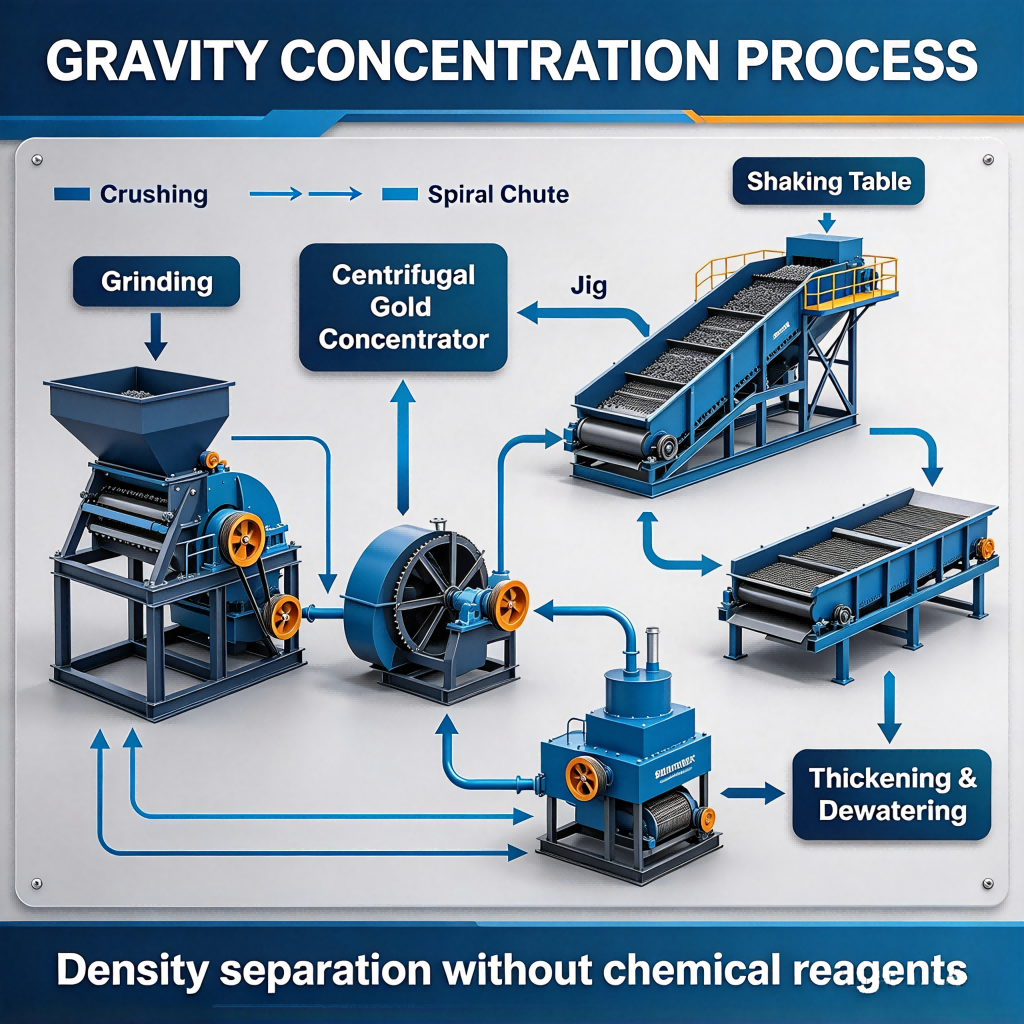
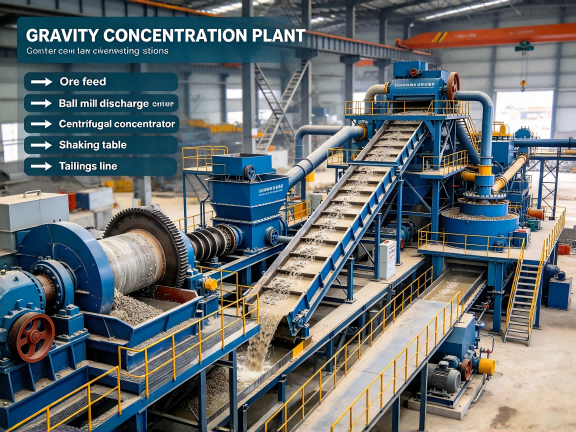
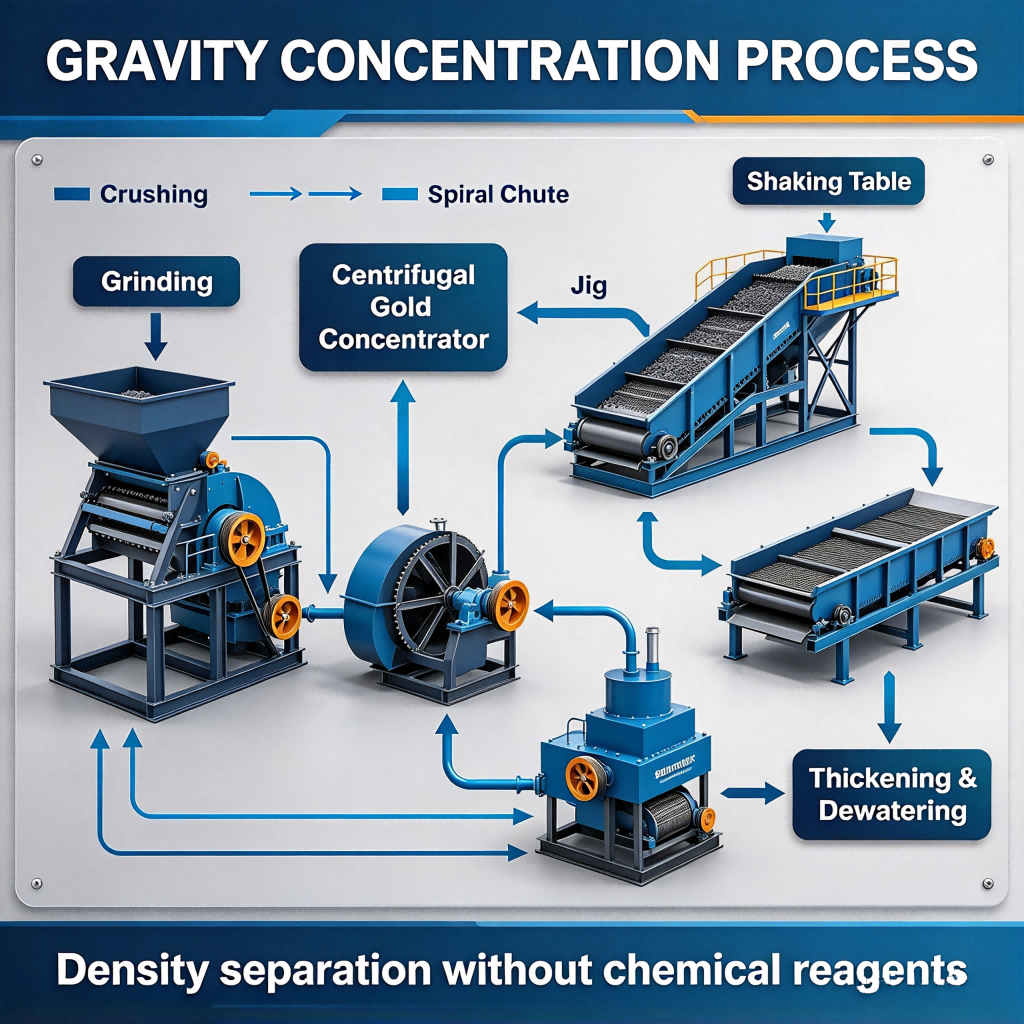
Gravity Concentration Process | Density-Based Mineral Separation Plant for Gold, Tin, Tungsten & Iron Ore
1. Process Overview
Gravity Concentration is a mineral separation process that separates valuable minerals from gangue based on differences in specific gravity (density). After crushing and grinding, heavy target minerals — such as free gold, cassiterite, scheelite, chromite and hematite — sink and get enriched under water flow, centrifugal force or vibration, while light waste rock is carried away as tailings.
No chemical reagents are used. Gravity concentration is an environmentally friendly, low-energy process widely deployed in gold, tin, tungsten, chromite and iron ore projects across Africa, Latin America, Central Asia and Southeast Asia. It is often installed as a pre-concentration step after crushing or as a supplementary recovery circuit after grinding.
2. Working Principle
The process relies on the density difference between target minerals and gangue. In water, heavy minerals settle faster than light minerals under gravity, centrifugal force or flowing water. By controlling water flow, bed movement and centrifugal acceleration, the equipment stratifies the slurry layers: dense minerals concentrate at the bottom and are collected as concentrate, while lighter gangue overflows as tailings.
3. Key Advantages of Gravity Concentration
- No Chemical Reagents — Pure physical separation, no flotation chemicals, environmentally friendly and safe for sensitive areas.
- Low Energy Consumption — Only pumps and drives consume power; overall operating cost is lower than flotation.
- Simple Operation & Maintenance — Straightforward equipment, easy to operate, minimal training required for local workers.
- High Recovery for Heavy Minerals — Excellent recovery for coarse and medium free gold, tin, tungsten, chromite and iron ore particles.
- Water Recycling Friendly — Tailings water can be clarified and recycled easily without chemical residue treatment.
- Flexible Configuration — Can be used as a standalone process (alluvial gold, tin) or combined with flotation / CIL for hard rock gold.
4. Suitable Ore Types
Ideal Ores:
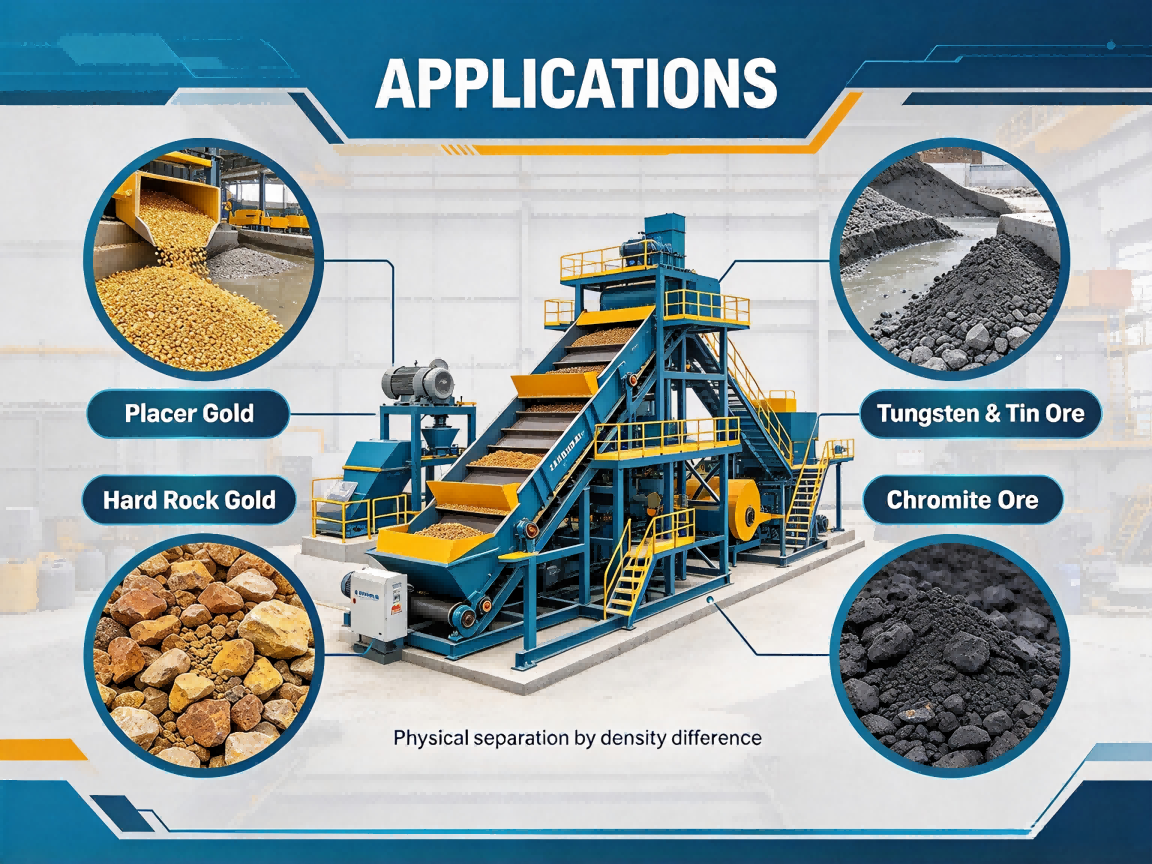
- Placer / alluvial gold ore (free native gold particles)
- Hard rock gold with liberated coarse free gold
- Cassiterite (tin ore), wolframite / scheelite (tungsten ore)
- Chromite, hematite, magnetite iron ore
- Coltan, tantalum-niobium and other heavy rare metal ores
Not Ideal:
- Ultra-fine minerals below 40 µm (gravity separation efficiency drops sharply)
- Gold / metal locked inside sulfide minerals (requires flotation or CIL)
- Ores with minimal density difference between mineral and gangue
5. Complete Gravity Concentration Equipment
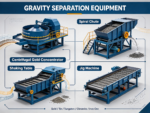
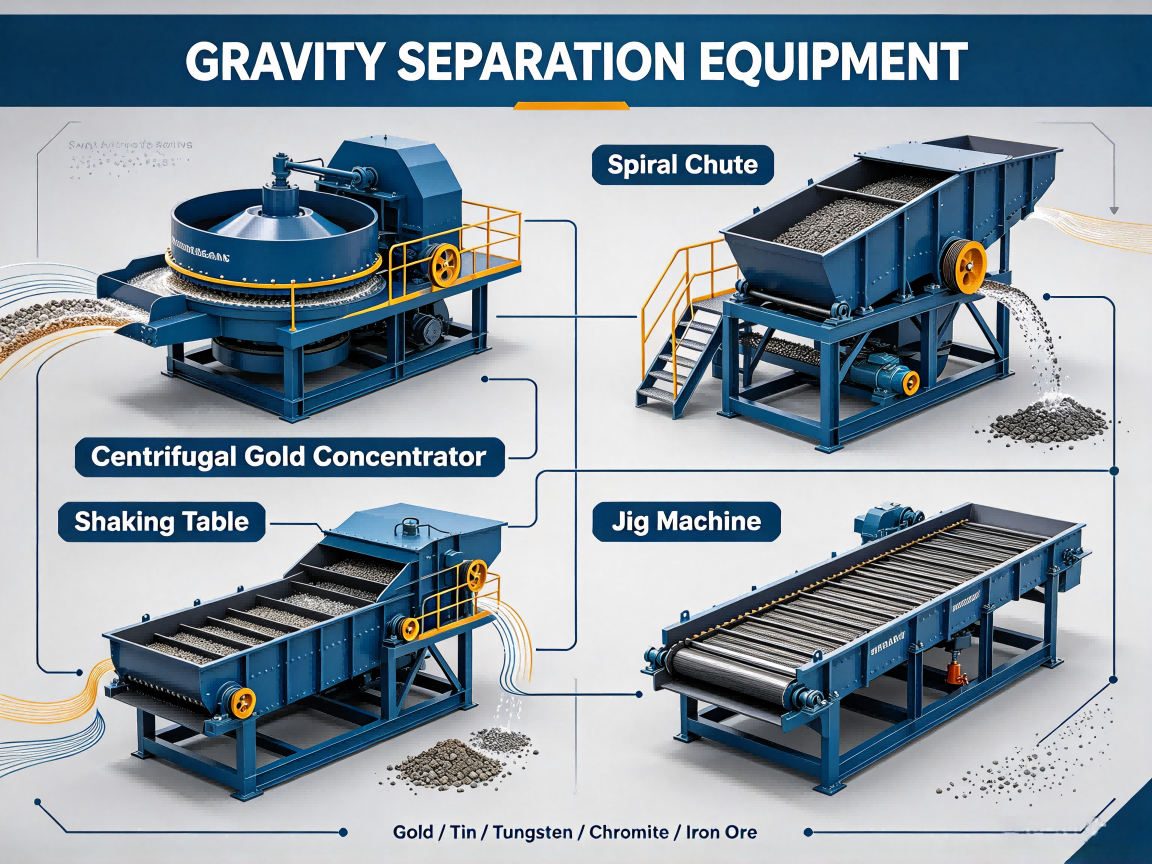
5.1 Centrifugal Gold Concentrator (Knelson Type)
- High G-force (up to 60 G) gravity separator
- Recovers coarse and medium free gold from grinding circuit
- Models STL-60 to STL-150, capacity 1 – 40 t/h
5.2 Shaking Table
- Classic wet gravity separator for fine minerals
- Final cleaning step for gold, tin, tungsten and tantalum concentrate
- Capacity 0.5 – 3 t/h per table, multiple tables in parallel
5.3 Spiral Chute
- Compact, no-motor gravity separator
- Handles large volumes of fine-grained heavy mineral slurry
- Used for pre-concentration of gold, iron ore and chromite
5.4 Jig Machine
- Jigging separator for coarse to medium particles
- Common in placer gold, tin and tungsten operations
- Uses pulsating water flow to stratify heavy and light layers
5.5 Supporting Equipment
- Slurry Pumps & Piping
- Feeding Hopper & Distributor
- Tailings Thickener (water recovery)
- Concentrate Collection & Dewatering
6. Typical Process Flow
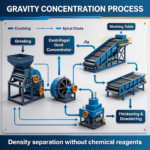
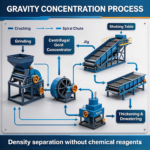
Run-of-Mine Ore → Crushing → Grinding → Classification → Gravity Concentration (Centrifugal / Jig / Spiral / Shaking Table) → High-Gravity Heavy Mineral Concentrate | Light Gangue Tailings → Thickening → Water Recycling
For hard rock gold projects, gravity concentration is often followed by flotation or CIL leaching to recover any remaining fine or locked gold. For alluvial gold, gravity concentration alone produces final gold concentrate ready for smelting.
7. Consumables & Spare Parts
- Centrifugal Concentrator Bowl Liners — Replaceable rifling grooves, 6 – 12 month service life
- Shaking Table Covering / Deck — Ripples / carpet replacement for the table surface
- Spiral Chute Liners (Polyurethane) — Wear-resistant surface lining
- Jig Screen Mesh / Jigging Sieve — Replaceable screens
- Pump Impellers & Liners — Slurry pump wear parts
- Drive Belts & Bearings — For shaking table and centrifugal drive units
8. FAQ for Gravity Concentration Process
Q1: What is gravity concentration in mineral processing?
A1: Gravity concentration separates minerals by density difference. Heavy minerals (gold, tin, tungsten, chromite) settle faster than light gangue under water flow, centrifugal force or vibration. It uses no chemicals and is widely used for heavy mineral recovery.
Q2: What minerals are suitable for gravity concentration?
A2: Gold (free native gold), cassiterite (tin), scheelite / wolframite (tungsten), chromite, hematite / magnetite iron ore, coltan and other heavy minerals. The key requirement is a clear density difference between the target mineral and gangue.
Q3: Does gravity concentration use flotation reagents?
A3: No. Gravity concentration is purely physical separation based on density and water flow. No flotation reagents, no cyanide, no chemicals are involved. Tailings water can be clarified and recycled easily.
Q4: Where is gravity concentration placed in the processing flow?
A4: It is normally installed after grinding and classification. For placer gold, it can be the main and only process. For hard rock gold, it is used as a pre-concentration step to capture coarse free gold before flotation or CIL leaching.
Q5: What is the difference between centrifugal concentrator and shaking table?
A5: A centrifugal concentrator uses high G-force (up to 60 G) for primary recovery of large tonnage free gold. A shaking table uses 1 G gravity and is used for final cleaning and upgrading of concentrate. Both are often used together: centrifugal for bulk recovery, shaking table for final concentrate polishing.
Q6: Can gravity concentration replace flotation or CIL?
A6: Only for free, liberated heavy minerals. If gold is locked inside sulfide minerals or particles are extremely fine, gravity recovery will be incomplete, and flotation or CIL leaching is still required. Gravity is a supplementary or standalone process, not a universal replacement.
Q7: Do you provide full gravity concentration plant design and equipment supply?
A7: Yes. We provide ore testwork, process flowsheet design, full equipment supply (centrifugal concentrator, shaking table, spiral chute, jig), installation guidance, commissioning and long-term after-sales support for gold, tin, tungsten and iron ore projects worldwide.
Ready to Build Your Gravity Concentration Plant?
Send us your ore type, mineral composition, target capacity and mine location. Our engineers will design a customized gravity concentration flowsheet and recommend the right equipment combination for your project.
What to send: Ore type / target mineral (gold, tin, tungsten, chromite, iron) / daily throughput / particle size distribution / mine location


Get in touch
Have a project in mind ? Send us your ore assay report, mine location and target capacity. Our mining engineers will prepare a customized process design, equipment list and quotation within 48 hours.