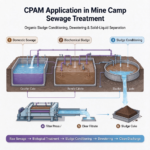
Cationic Polyacrylamide (CPAM) is a positively charged water-soluble polymer flocculant. It is widely used for organic sludge dewatering, mine camp domestic sewage treatment and biochemical wastewater conditioning, forming compact sludge cakes and reducing sludge volume efficiently.
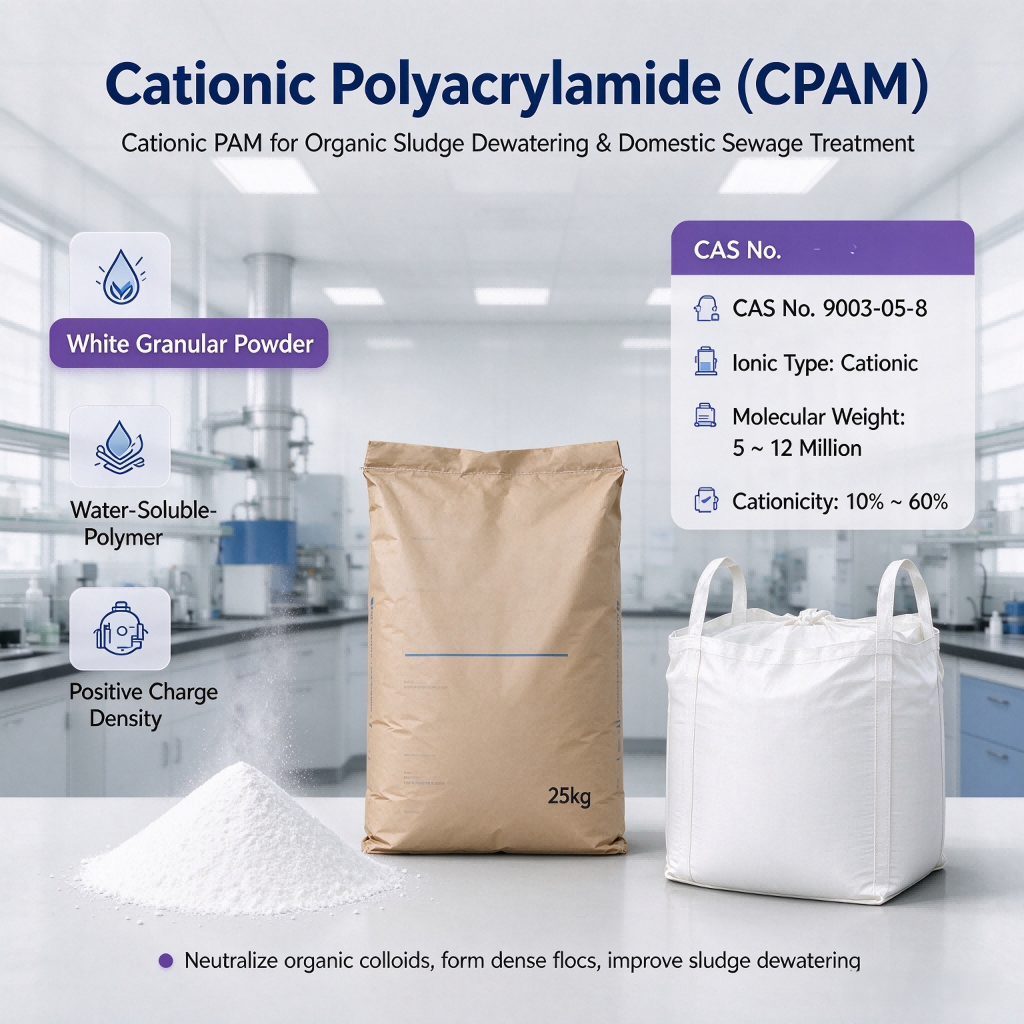
CPAM / Cationic PAM
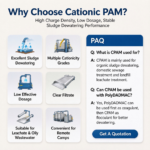
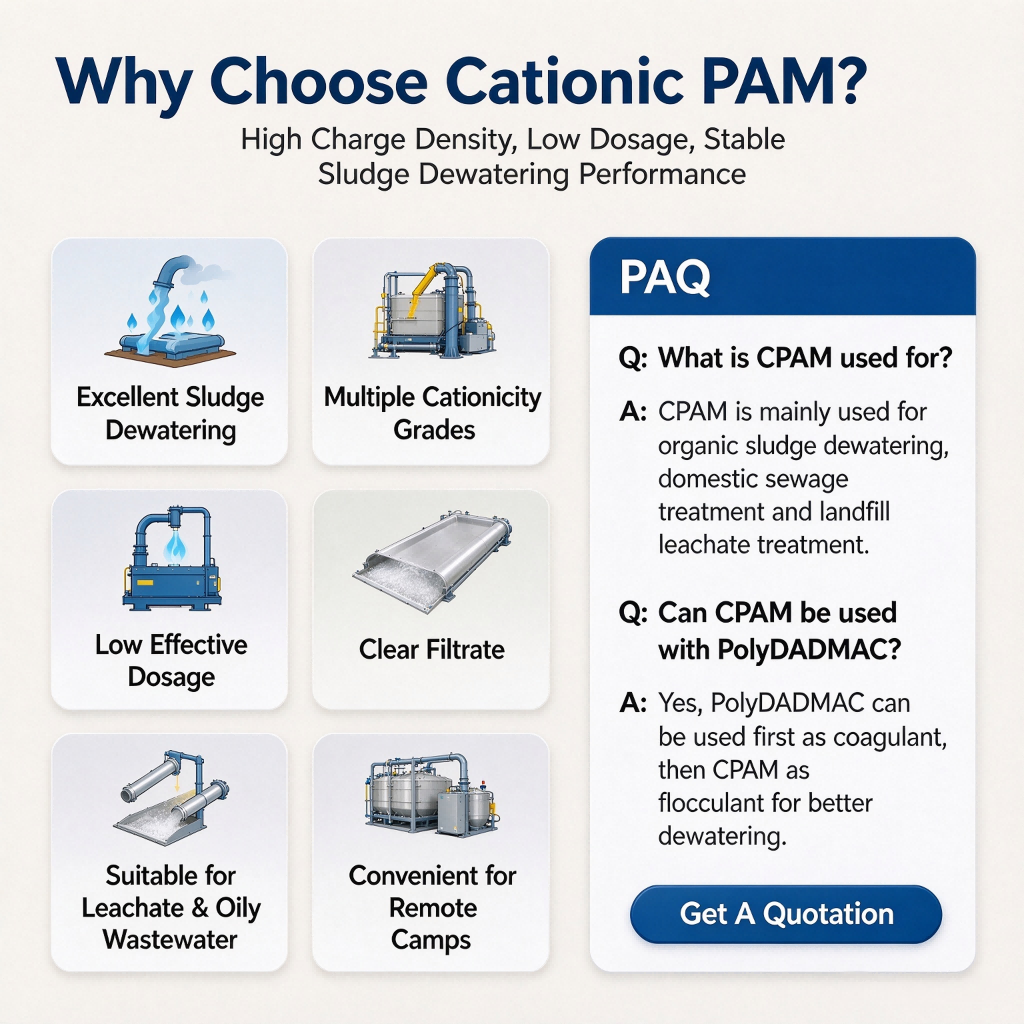
- - Excellent organic sludge dewatering effect, greatly lower sludge moisture content
- - Multiple cationicity grades (10%–60%) available for different sludge types
- - Low effective dosage, reduces chemical operating cost
- - Produces non-sticky sludge cake and clear filtrate
- - Stable performance for domestic sewage, leachate and oily wastewater
- - Dry powder form, convenient storage and transport to remote mine camps
- - Export documents including MSDS, COA, TDS are available
Cationic Polyacrylamide (CPAM / Cationic PAM)
Cationic Flocculant for Organic Sludge Dewatering, Domestic Sewage & Wastewater Treatment
Product Introduction
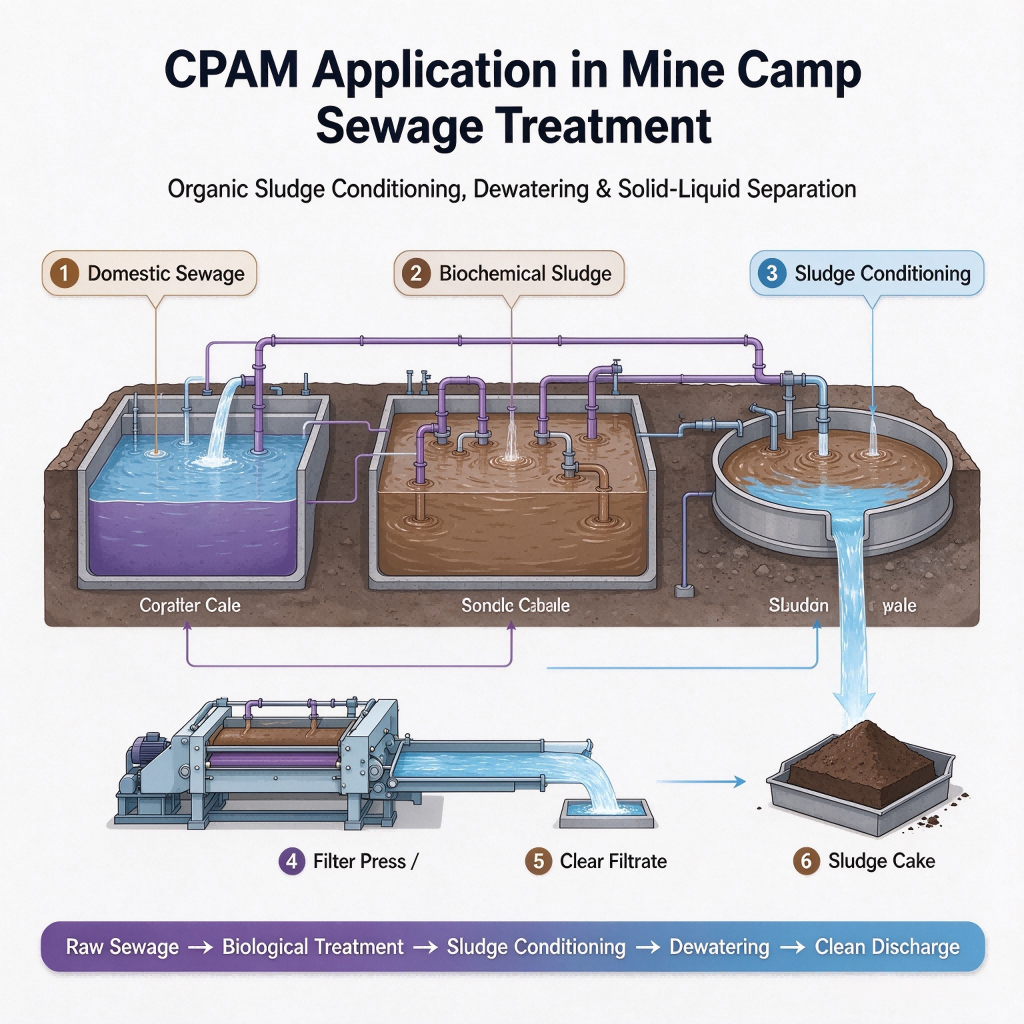
Cationic Polyacrylamide (CPAM) is a water-soluble cationic polyelectrolyte polymer with positively charged molecular chains. It can neutralize negatively charged organic colloids and suspended solids rapidly, aggregate fine particles into compact flocs, and achieve solid-liquid separation efficiently.
It is widely applied for organic sludge dewatering, mine camp domestic sewage treatment, biochemical sludge conditioning, food wastewater, landfill leachate and oily wastewater. It is the preferred chemical for filter press, belt press and centrifuge sludge dewatering systems.
Technical Specifications
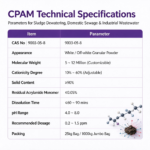
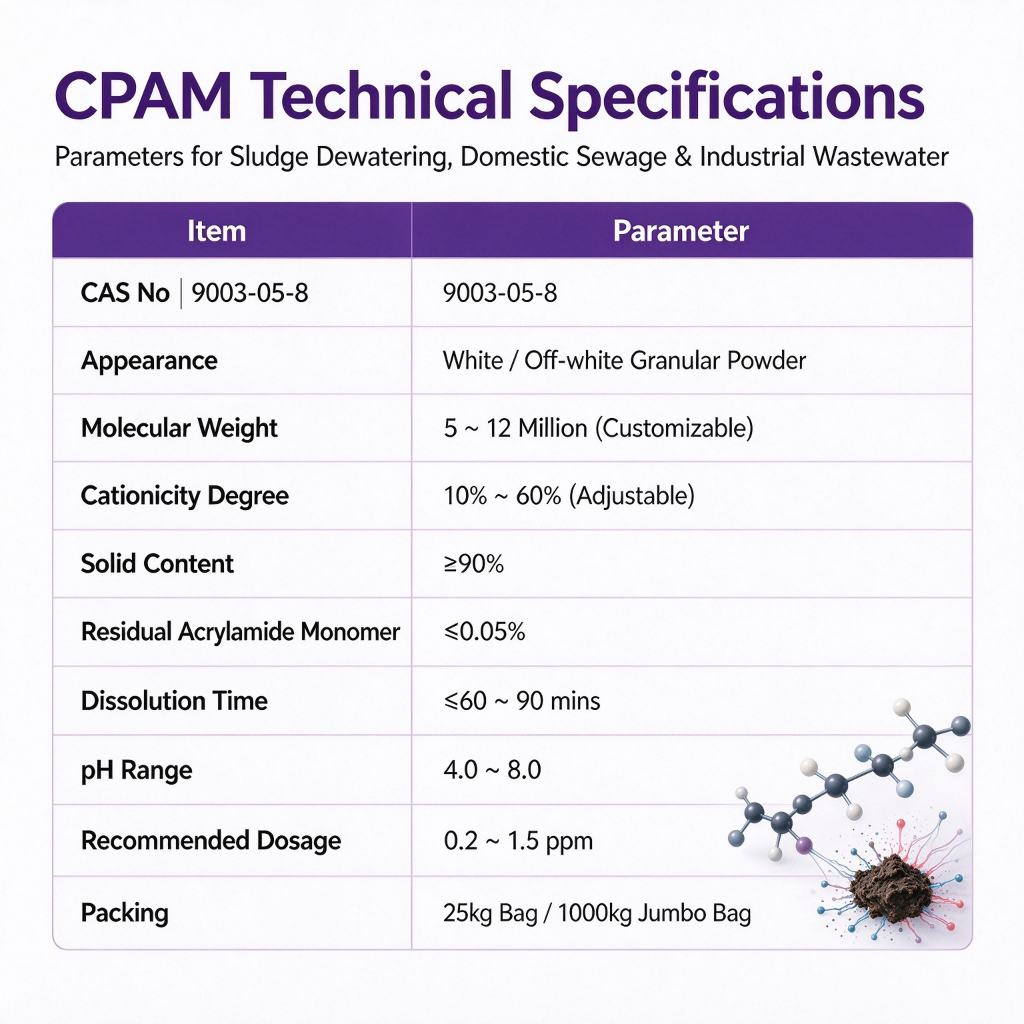
| Item | Parameter |
|---|---|
| CAS No. | 9003-05-8 |
| Appearance | White / Off-white Granular Powder |
| Ionic Type | Cationic |
| Molecular Weight | 5 Million ~ 12 Million (Customizable) |
| Cationicity Degree | 10% ~ 60% (Adjustable) |
| Solid Content | ≥90% |
| Residual Acrylamide Monomer | ≤0.05% |
| Dissolution Time | ≤60 ~ 90 mins under stirring |
| Suitable pH Range | 4.0 ~ 8.0 (Weak acid to neutral) |
| Recommended Dosage | 0.2 ~ 1.5 ppm; 20–100 g per ton of wet sludge |
| Packing | 25kg Kraft Paper Bag / 1000kg Jumbo Bag |
Key Advantages & Benefits
- Excellent Sludge Dewatering Performance: Form tight and hydrophobic flocs, reduce sludge moisture content significantly for filter press and centrifuge.
- Low Consumption & Cost Effective: High charge density achieves good dewatering effect with low dosage, saving chemical cost for camp sewage station.
- Wide Adaptability to Organic Sewage: Works stably for biochemical sludge, domestic sewage sludge, leachate and oily wastewater.
- Clear Filtrate & Easy Sludge Cake Discharge: Less sticky sludge cake, filtrate clean and easy for further treatment.
- Multiple Cationic Grades: Various cationicity available to match different sludge properties from mine camp sewage system.
- Convenient Storage & Transportation: Dry powder form, stable storage, convenient for remote mine site delivery.
Typical Applications
- Organic sludge dewatering for mine camp domestic sewage plant
- Biochemical sludge conditioning & dewatering
- Landfill leachate wastewater treatment
- Food, slaughter and oily wastewater flocculation
- Dyeing & papermaking sludge dewatering
- Small integrated sewage treatment equipment for remote camps
FAQ
Q1: What is the main difference between Cationic PAM and Anionic PAM?
A1: CPAM carries positive charge, mainly used for organic sludge dewatering and domestic sewage. Anionic PAM is negatively charged, suitable for inorganic tailings and sand washing wastewater sedimentation.
Q2: How to select the right cationicity of CPAM?
A2: Low cationicity (10–20%) for easy-filter sludge; medium cationicity (30–40%) for common domestic sludge; high cationicity (50–60%) for sticky sludge like leachate sludge. Jar test is recommended before formal use.
Q3: How to prepare CPAM solution properly?
A3: Prepare 0.1% ~ 0.3% aqueous solution. Sprinkle powder slowly into continuously stirred clean water to avoid caking. Prepared solution should be consumed within 24 hours.
Q4: Can you provide MSDS, COA and TDS for export clearance?
A4: Yes, MSDS, COA and technical datasheet are available for customs declaration and project bidding documents.
Q5: What is your MOQ and production lead time?
A5: MOQ is 1 ton. Lead time 7–12 working days after deposit. FOB and CIF shipping terms are acceptable for mine camp projects.
Q6: Can CPAM be used together with PolyDADMAC?
A6: Yes. PolyDADMAC can be dosed first as coagulant to remove colloids, then CPAM for flocculation and sludge conditioning to improve dewatering result.
Related Products



Get in touch
Have a project in mind ? Send us your ore assay report, mine location and target capacity. Our mining engineers will prepare a customized process design, equipment list and quotation within 48 hours.